How to Hire a Flooring Contractor Without Getting Burned (From the Inside)
Hiring a flooring contractor comes down to five things: verifying their license and insurance, checking references on completed local jobs, understanding what's in the contract, knowing what questions to ask about your specific flooring type, and recognizing the red flags that most homeowners miss. This guide comes from a contractor who's seen what happens when people skip those steps.
We're going to tell you exactly how to evaluate us and every other installer you're considering. Why? Because the homeowners who do their homework before signing a contract are the ones who end up happy with their floors. The ones who don't are the ones writing angry reviews six months later about gaps, squeaks, and finish failures.
The flooring industry has a problem. The barrier to entry is low. A truck, a nail gun, and a business card is all it takes for someone to call themselves a flooring installer. That doesn't make them qualified to install your Solid Hardwood, Engineered Hardwood, or SPC Luxury Vinyl floors correctly.
The Non-Negotiables: What Every Flooring Contractor Must Have
Before you discuss colors, species, or pricing with any flooring contractor, verify three things: a valid Massachusetts Home Improvement Contractor registration, current general liability and workers' compensation insurance, and a verifiable track record of completed flooring projects in your area.
Look, we know this isn't the exciting part. Nobody starts a flooring project thinking about insurance certificates. But skipping this step is the single most common mistake homeowners make, and it's the one that causes the most expensive problems.
A general contractor is responsible for managing all aspects of a project, from permits to subcontractors. But flooring installation is specialty work, and plenty of general contractors sub it out to whoever's cheapest and available. You want to know who's actually touching your floors, and you want to verify that specific company or individual is properly credentialed.
Here's the non-negotiable checklist:
- Massachusetts HIC registration - Every contractor doing home improvement work over a certain threshold in Massachusetts must be registered. Ask for the number. Verify it online through the state's lookup tool. If they can't provide it, walk away.
- General liability insurance - This covers damage to your property during the installation. Ask for a current certificate of insurance and confirm it's active by calling the insurer directly.
- Workers' compensation insurance - If a worker gets injured on your property and the contractor doesn't carry workers' comp, you could be personally liable. This isn't optional.
- Established business presence - A physical address, a working phone number, a website with actual project photos. Not just a Facebook page and a cell phone.
- Manufacturer certifications - For Engineered Hardwood and SPC Luxury Vinyl, many manufacturers require installers to be certified on their specific products. Improper installation can void your product warranty entirely.
| Credential | Why It Matters | How to Verify |
| MA HIC Registration | Legal requirement for home improvement work | State online lookup tool |
| General Liability Insurance | Covers property damage during installation | Request certificate, call insurer |
| Workers' Comp Insurance | Protects you from injury liability | Request certificate, call insurer |
| Manufacturer Certifications | Maintains product warranty validity | Ask for certificate, call manufacturer |
| BBB or Trade Association Membership | Indicates accountability and dispute resolution | Check organization's website |
The Questions That Separate Good Contractors from Bad Ones
The best way to evaluate a flooring contractor isn't by asking how long they've been in business. It's by asking technical questions about your specific installation and listening to whether their answers demonstrate real knowledge or rehearsed sales talk.
Anyone can tell you they've been installing floors for twenty years. That doesn't mean they've been doing it well for twenty years. The questions that actually reveal competence are the ones about process, preparation, and problem-solving.
Subfloor Prep Questions
The subfloor is everything. A beautiful hardwood floor installed over a subfloor that wasn't properly prepared will fail - it's just a matter of when. Ask these questions and pay attention to the specificity of the answers:
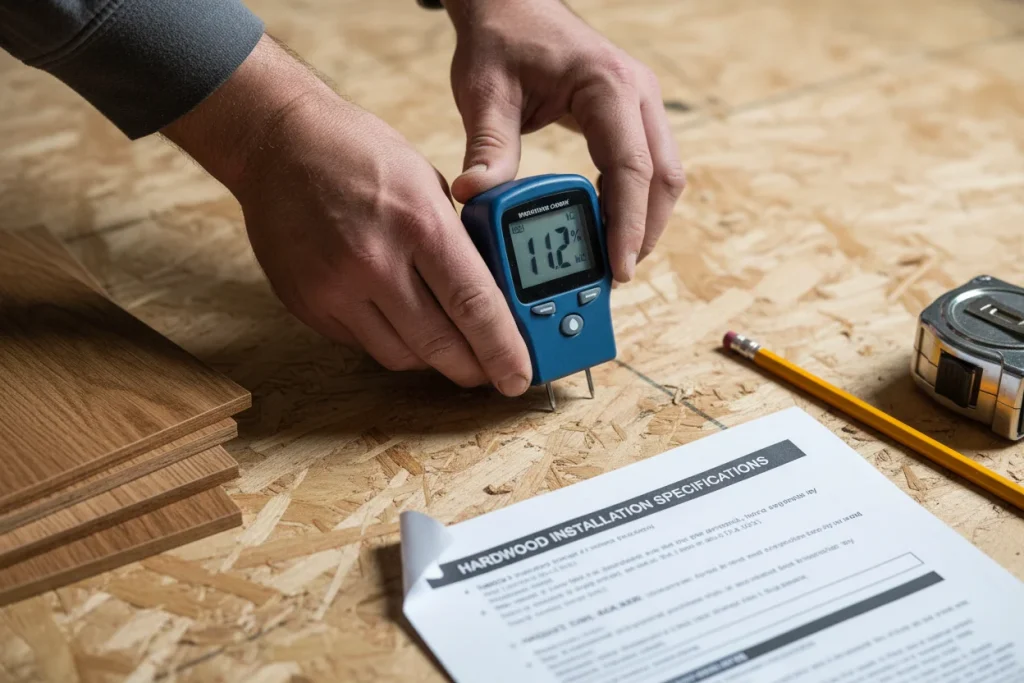
"What moisture testing do you do before installation?" A good contractor will describe their process for testing both the subfloor and the flooring material using a calibrated moisture meter. They should know the acceptable moisture differential between the subfloor and flooring for the product you're installing. If they say "we eyeball it" or "we don't worry about that," find someone else.
"How do you handle out-of-level subfloors?" Every subfloor has imperfections. A qualified installer will explain how they identify and correct them - whether that's grinding high spots, filling low spots with leveling compound, or addressing structural issues with the joists. If they tell you the flooring will "just go down over it," they'll leave you with a floor that bounces and creaks.
"How long do you acclimate the flooring before installation?" This is a trick question in a way. The answer depends on the product. Solid Hardwood typically needs several days to acclimate to your home's temperature and humidity. Engineered Hardwood needs less, and SPC Luxury Vinyl needs almost none because it's dimensionally stable. A contractor who gives the same answer for all three products doesn't understand the materials they're installing.
Contract and Process Questions
- "What does your contract include?" - It should detail the scope of work, materials, prep work, furniture moving (or not), timeline, payment schedule, and warranty
- "Who will be on site doing the work?" - Some companies sell the job with an experienced salesperson but send a different crew to install. You want to know who's actually doing the work.
- "How do you handle damage to baseboards, walls, or existing finishes?" - Flooring installation is physical work. Things get bumped. A professional contractor accounts for this and takes responsibility.
- "What's your warranty, and what does it actually cover?" - Separate the product warranty (from the manufacturer) from the labor warranty (from the contractor). Both matter.
Red Flags That Should Kill the Deal Immediately
Certain contractor behaviors reliably predict a bad experience. If you see any of these red flags during the estimation or sales process, they won't magically improve once the work starts.
The FTC advises homeowners to be cautious of contractors who pressure you for immediate decisions, ask for full payment upfront, or suggest you pull your own building permits. Those are scam indicators, and they apply to flooring projects just as much as any other home improvement work.
But there are flooring-specific red flags too. Here are the ones we see most often:
They don't ask about your home's humidity or HVAC system. Flooring and moisture are inseparable. Any installer who doesn't ask about your home's typical humidity levels, heating system type, or whether you have a dehumidifier in the basement isn't thinking about long-term floor performance. They're thinking about getting in, nailing down boards, and getting out.
They quote the job without seeing your subfloor. An accurate flooring estimate is impossible without inspecting the subfloor condition. If someone quotes you based solely on square footage, they're either planning to charge you extra later for prep work or to skip it entirely. Neither option is good.
They don't discuss acclimation. We mentioned this above, but it's worth repeating. If the contractor doesn't acclimate the flooring material to your home's environment before installation, they'll install material that hasn't reached equilibrium. The result, especially with Solid Hardwood, is winter gaps and summer buckling.
They push one product regardless of your situation. A contractor who recommends the same flooring for every room without considering moisture exposure, traffic patterns, subfloor type, and your lifestyle isn't giving you advice - they're moving inventory. Your kitchen might call for SPC Luxury Vinyl while your living room is better suited for Solid Hardwood. A good contractor helps you match the right product to each room.
| Red Flag | What It Usually Means | What to Do |
| No subfloor inspection before quoting | Prep costs will be added later or skipped | Insist on an on-site assessment |
| Demands full payment upfront | Cash flow problems or potential no-show | Never pay more than 30-50% deposit |
| No written contract | No accountability for scope, timeline, or quality | Walk away |
| Can't explain moisture testing process | Doesn't understand flooring science | Find a specialist |
| Same recommendation for every room | Selling product, not solving problems | Get a second opinion |
| No references or portfolio | No verifiable track record | Not worth the risk |
What a Good Flooring Contractor's Process Actually Looks Like

A professional flooring installation follows a predictable sequence: initial consultation and subfloor inspection, material selection and ordering, acclimation period, subfloor preparation, installation, and final inspection. If your contractor skips or rushes any of these steps, the floor's long-term performance is at risk.
We're laying out our own process here, not because we think everyone should do it exactly like we do, but because seeing what a complete process looks like gives you a benchmark. If the contractor you're evaluating is missing major steps, that tells you something.
Step 1: Site Visit and Subfloor Inspection
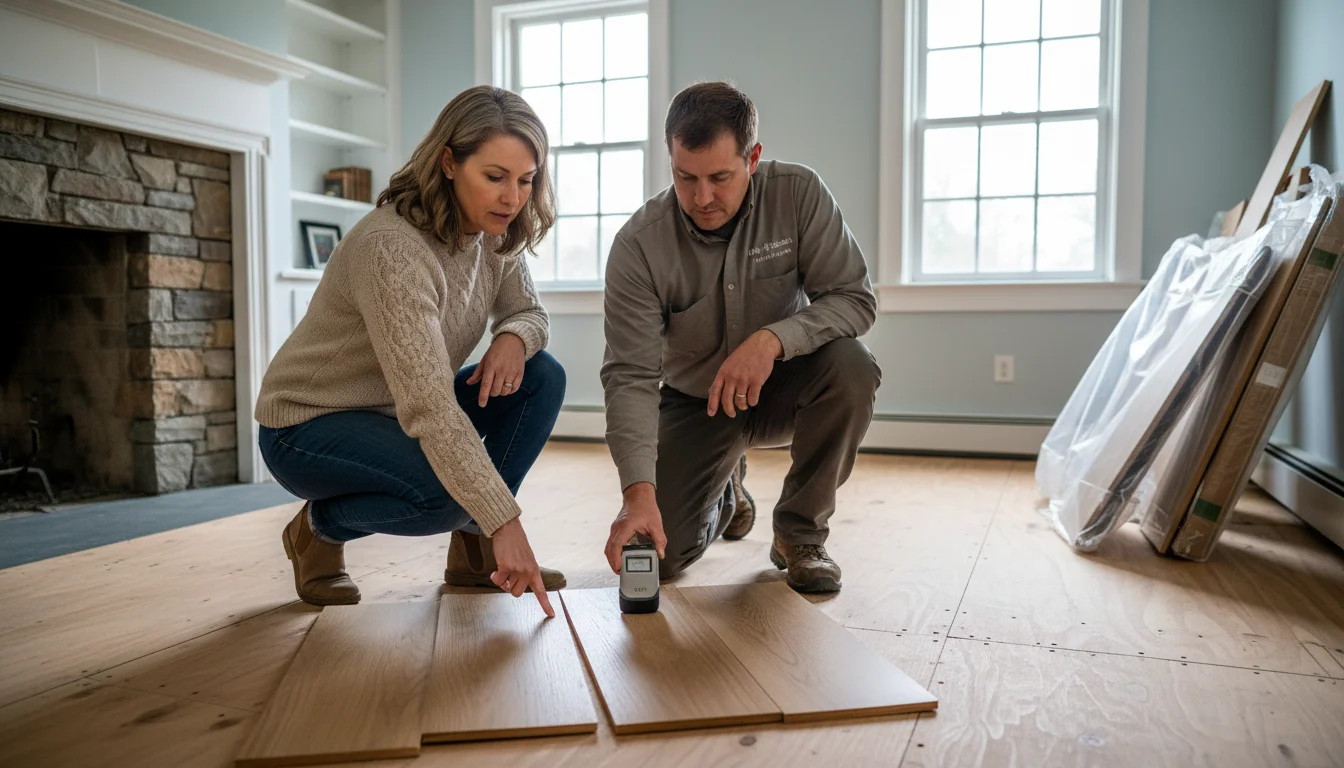
We visit your home, measure every room, and inspect the subfloor. We check moisture levels with a calibrated pin meter or relative humidity meter, identify any structural issues (soft spots, squeaky areas, out-of-level sections), and note the existing flooring that needs to be removed. This visit also lets us see your home's layout, lighting, and how rooms connect - all of which factor into flooring direction and transition planning.
Step 2: Material Selection and Consultation
Based on the subfloor conditions, your home's humidity environment, and how each room gets used, we recommend specific products. Solid Hardwood for main living areas and bedrooms where you want the real thing. Engineered Hardwood for rooms with concrete subfloors or where extra moisture stability is needed. SPC Luxury Vinyl for basements, mudrooms, and bathrooms where water exposure is a real concern. Each product has different installation requirements, and we explain those upfront.
Step 3: Acclimation, Prep, and Installation
Once materials arrive, Solid Hardwood acclimates in your home for several days. Meanwhile, we handle subfloor prep - grinding, leveling, cleaning, and moisture barrier installation where needed. Then installation proceeds room by room, followed by transitions, baseboards, and final cleanup.
Step 4: Final Walkthrough
We walk every room with you. We check for any visible issues - gaps, scratches, finish inconsistencies - and address them on the spot. We review care and maintenance for your specific flooring type and leave you with written warranty documentation for both the product and our labor.
Key Takeaways
- Verify license, insurance, and certifications before discussing anything else - these are non-negotiable prerequisites, not afterthoughts
- Ask technical questions about subfloor prep, moisture testing, and acclimation - the answers reveal whether the contractor understands flooring science or just knows how to swing a nail gun
- Red flags during the sales process predict red flags during installation - pressure tactics, no-inspection quotes, and cash-only demands are reliable warning signs
- Get everything in writing - scope, materials, prep work, timeline, payment schedule, and separate warranties for product and labor
- Match the flooring product to the room - a good contractor recommends Solid Hardwood, Engineered Hardwood, or SPC Luxury Vinyl based on each room's conditions, not their inventory
- Check references by visiting completed jobs - photos on a website aren't enough, and completed projects you can walk on tell you more than any testimonial
Frequently Asked Questions
How do I verify a flooring contractor's license in Massachusetts?
Massachusetts requires home improvement contractors to be registered with the state. Ask for the contractor's HIC registration number and verify it through the state's online contractor lookup tool on mass.gov.
Should I get multiple estimates for a flooring project?
Yes. Three written estimates from different contractors gives you a realistic range for your project and lets you compare not just numbers but scope of work, materials specified, and included prep work. The cheapest bid isn't always the best value.
What's a reasonable deposit for a flooring installation?
Most reputable contractors ask for a deposit between 30% and 50% to cover material ordering costs. Never pay the full amount before work begins. Final payment should be held until you've completed a walkthrough and are satisfied with the installation.
How long should hardwood flooring acclimate before installation?
Solid Hardwood typically needs three to seven days to acclimate in your home's environment, depending on the species and your home's humidity levels. Engineered Hardwood needs less time, and SPC Luxury Vinyl generally requires minimal to no acclimation because of its dimensional stability.
What's the difference between a product warranty and a labor warranty?
The product warranty comes from the flooring manufacturer and covers defects in the material itself. The labor warranty comes from your contractor and covers installation workmanship. Both are important, and improper installation can void the product warranty entirely.
Can a flooring contractor install all types of flooring?
Not necessarily. Solid Hardwood nail-down installation, Engineered Hardwood glue-down or floating installation, and SPC Luxury Vinyl click-lock installation each require different skills and tools. Ask specifically about your product type and check for manufacturer certifications.
What should a flooring contract include?
A proper contract should specify the exact materials being installed, all prep work included, furniture handling, timeline, payment schedule, cleanup responsibilities, and separate warranty terms for both product and labor. If it's vague on any of these, ask for clarification before signing.
How do I know if my subfloor needs work before new flooring goes in?
A qualified contractor will test your subfloor for moisture content, check for level (typically within 3/16 inch over 10 feet for most flooring products), and identify any structural concerns. This assessment should happen during the initial site visit, not on installation day.
Is it worth hiring a specialist flooring contractor over a general contractor?
For most flooring projects, yes. A dedicated flooring installation company works with these products daily and understands the science behind moisture management, acclimation, and subfloor prep at a deeper level than a general contractor who subs out the flooring work.
What happens if my new floors develop problems after installation?
Contact your contractor immediately. Legitimate flooring problems - gaps, cupping, finish failure - usually have identifiable causes. Your labor warranty should cover installation defects, and your product warranty covers manufacturing defects. Document the issue with photos and written communication.
Conclusion
Hiring a flooring contractor isn't complicated, but it does require asking the right questions and paying attention to the answers. The contractors who take shortcuts on credentials, subfloor prep, and communication are the same ones who'll take shortcuts on your installation. The ones who answer your questions thoroughly, show you completed local work, and put everything in writing are the ones worth trusting with your floors.
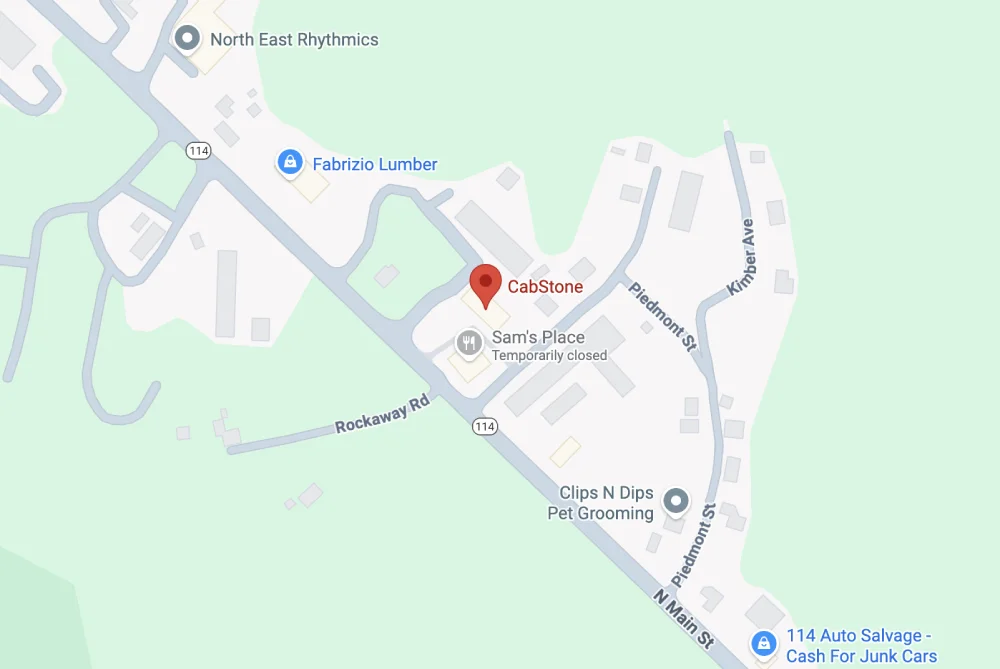
CabStone installs Solid Hardwood, Engineered Hardwood, and SPC Luxury Vinyl flooring across the North Shore and greater Boston area. If you want to see how we stack up against this checklist, call us at 617-699-3945 or visit 325A North Main Street, Middleton, MA 01949.