Custom vs Semi-Custom vs Stock Cabinets: How to Choose for Your Budget
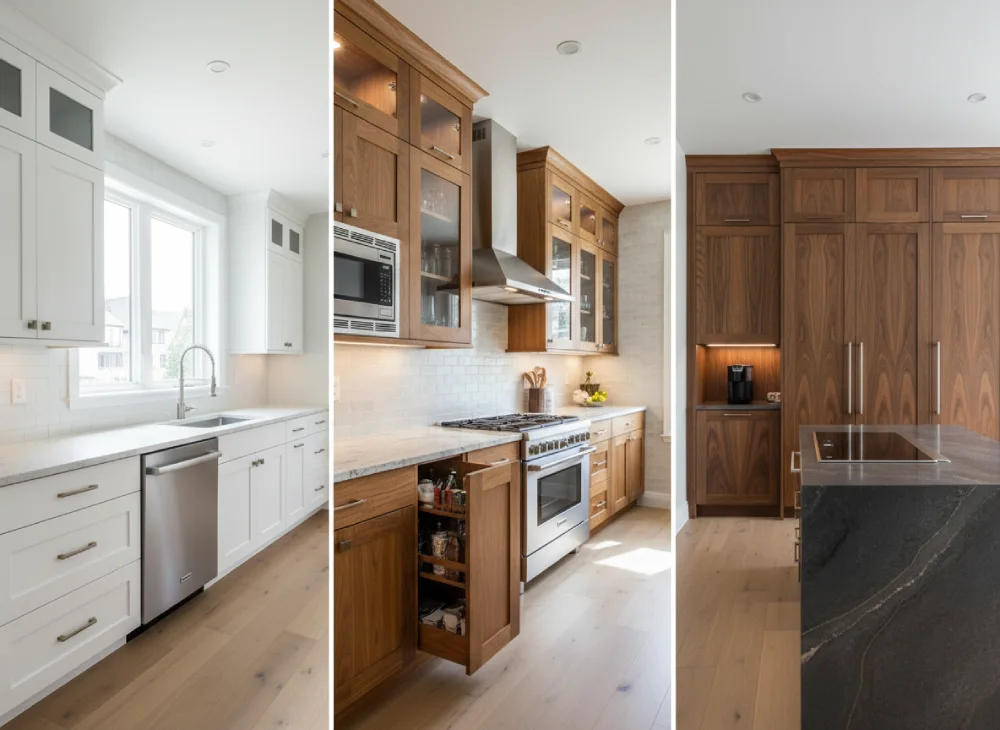
Cabinets come in three basic types—stock, semi-custom, and custom—each defined by a specific balance of cost, customization options, and lead times that determines which cabinet type best fits your budget, timeline, and vision for your kitchen renovation.
Understanding the similarities and differences between custom cabinetry, semi-custom cabinets, and stock cabinet options empowers homeowners to make informed decisions that align with their priorities. Stock cabinets are pre-built in standard sizes and are available immediately at the lowest cost but offer limited variety.
Semi-custom cabinets provide a balance of personalization and value, allowing modifications to cabinet sizes, door styles, and organization inserts. Custom cabinets offer unlimited design freedom with exact specifications tailored to any kitchen layout, though they require the highest investment.
Working with an experienced cabinet maker helps you decide which type of cabinet delivers the best value for your specific renovation, whether you're renovating on a tight budget or creating your dream kitchen with custom-built solutions.
Key Takeaways
- Stock cabinets are the cheapest cabinet option: Pre-manufactured in standard sizes, stock cabinetry costs $100–$300 per linear foot with immediate availability, but cabinets are generally limited to fixed 3-inch size increments and basic door styles and colors.
- Semi-custom cabinets offer the best value: This cabinet type balances quality and personalization at $400–$900 per linear foot, allowing 1-inch size adjustments and extensive customization options without the premium price of fully custom pieces.
- Custom cabinets offer unlimited design freedom: Built by skilled craftsmen to exact specifications, custom-built cabinets cost $1,000-plus per linear foot but provide perfect fits for any kitchen layout with any wood types, colors and finishes, and hardware choices to create truly personalized looks.
- Lead times increase with customization: Stock cabinets are available in 0–3 weeks, semi-custom cabinets require 4–8 weeks, and custom options need 8–16-plus weeks for production by woodworkers or custom cabinet makers.
- Semi-custom cabinetry maximizes space efficiency: Unlike stock cabinets that use filler strips to accommodate standard sizes, semi-custom and custom options adjust to fit exact dimensions, eliminating wasted space and providing better storage solutions.
- Material quality correlates with price: Stock cabinetry often uses particleboard, semi-custom cabinets provide plywood construction, and custom cabinetry features solid wood with premium craftsmanship including dovetail joinery and hand-applied finishes.
Understanding the Three Basic Types of Cabinets
Cabinets are made in three distinct tiers, each serving different homeowner needs based on budget constraints, timeline requirements, and desired customization levels. Understanding which cabinet type aligns with your priorities ensures you invest wisely in your kitchen renovation.
The Core Differences Explained
Stock cabinets represent the "fast food" of cabinetry—pre-manufactured in factories, stored in warehouses, and ready to ship immediately. These cabinets come in fixed dimensions with zero flexibility in size or finish adjustments. The trade-off for affordability and speed is limited personalization.
Semi-custom cabinets function as the "fast casual" hybrid option. Manufacturers start with standard base designs but allow modifications before production begins. Homeowners can alter depths, widths, drawer configurations, and door style selections to create a personalized look that fits their specific kitchen layout better than stock options.
Custom cabinets represent "fine dining"—built entirely from scratch by skilled craftsmen to homeowners' exact specifications. Whether custom cabinet dimensions match unusual wall angles or custom-built features accommodate specific storage needs, this tier offers unlimited design freedom with premium quality materials.
Stock Cabinets: The Budget and Speed Choice
Stock cabinets are pre-built and mass-produced in factories, then stored until purchase. Cabinets are available in standard 3-inch increments (12", 15", 18" widths) and cannot be altered after manufacturing.
| Stock Cabinet Features | Details |
| Price Range | $100–$300 per linear foot |
| Lead Time | 0–3 weeks (often same-day pickup) |
| Size Options | Fixed 3-inch increments only |
| Materials | Particleboard boxes, laminate veneers |
| Finish Choices | 5–10 standard colors (white, gray, natural) |
| Best For | DIY projects, rentals, tight budgets, quick timelines |
When Stock Cabinetry Makes Sense
Stock cabinets would be ideal for rental properties, laundry rooms, or basement renovations where budget and speed outweigh customization needs. If you need cabinet installation this weekend or you're flipping a house on a tight margin, ready-to-assemble (RTA) cabinets provide immediate solutions.
The quality of modern stock cabinets, particularly RTA cabinets from reputable manufacturers, has improved significantly. Factory-baked finishes are durable and consistent, often outlasting field-applied finishes on custom work. For straightforward kitchen layouts with standard dimensions, stock options deliver functional storage at minimal cost.
Stock cabinet advantages:
- Immediate availability: Pick up today or receive delivery within days
- Lowest cost: Budget-friendly for multiple rooms or large spaces
- DIY-friendly: Ready-to-assemble options simplify installation
- Consistent quality: Factory production ensures uniform standards
However, the limitations are significant. If your wall measures 58 inches and you install two 27-inch cabinets (totaling 54 inches), you must use a 4-inch filler strip to bridge the gap. This wastes valuable storage space and creates visible seams that compromise aesthetics.
Stock Cabinet Limitations
Stock cabinetry offers limited variety in door styles—typically restricted to popular designs like Shaker panels in a handful of colors. The range of door styles and hardware choices pale compared to semi-custom alternatives. Material quality suffers as well, with particleboard construction and laminate surfaces rather than solid wood or quality plywood.
Space efficiency represents perhaps the biggest drawback. Because cabinets are generally manufactured in 3-inch increments, achieving perfect fits requires extensive use of filler strips that reduce usable storage. For homeowners with non-standard kitchen layouts, stock options rarely provide satisfactory solutions.
Semi-Custom Cabinets: The Value Hybrid
Semi-custom cabinets represent the industry sweet spot where quality meets value. Manufacturers start with stock cabinet bases but allow modifications to dimensions and features before production begins. This cabinet type delivers approximately 90% of custom cabinet functionality at roughly 60% of the cost.
Customization Options Available
Semi-custom cabinets provide flexibility to adjust cabinet sizes in 1-inch increments rather than 3-inch jumps. This precision allows homeowners to maximize every inch of kitchen space. You can reduce cabinet depth from standard 24 inches to 18 inches for narrow galley kitchens, increase heights for cathedral ceilings, or specify exact widths to eliminate filler strips.
Semi-custom personalization includes:
- Dimensional flexibility: Adjust width, depth, and height in 1-inch increments
- Extensive door styles: Hundreds of options from traditional to contemporary
- Finish variety: Dozens of stains, paints, and glazes
- Interior accessories: Pull-out spice racks, trash bins, drawer dividers, organization inserts
- Hardware choices: Extensive knob, pull, and hinge selections
- Specialty features: Glass doors, open shelving, appliance garages
The amount of customization semi-custom cabinets offer allows homeowners to create highly personalized looks without commissioning fully custom work. You can mix and match features—combining glass-front uppers with pull-out drawers in base cabinets, or integrating soft-close mechanisms throughout.
Semi-Custom Construction Quality
Semi-custom cabinets are high-quality cabinets featuring plywood box construction that surpasses stock particleboard. The wood veneer or solid wood doors provide authentic appearance and durability. Many semi-custom lines include dovetail drawer construction, undermount soft-close drawer glides, and concealed European hinges as standard features.
This tier offers exceptional value for most kitchen renovations. Whether you're updating your forever home or preparing for resale, semi-custom cabinetry provides the quality and customization potential to help you decide on designs that significantly enhance your space.
Timeline and Investment
Semi-custom cabinets require 4–8 weeks for production since they're made-to-order. This timeline allows manufacturers to build cabinets to your specifications while maintaining efficient production processes. Costs range from $400–$900 per linear foot depending on door style complexity, finish choices, and accessory selections.
While this represents a significant investment over stock options, the benefits justify the premium. Better space utilization, superior construction, and extensive variety of door styles enable you to bring your vision to life within reasonable budgets. For most homeowners, semi-custom cabinets would deliver the ideal balance of quality, personalization, and value.
Custom Cabinets: The Bespoke Luxury Choice
Custom cabinets are built from scratch by skilled woodworkers or a specialized custom cabinet maker to homeowners' exact specifications. There are no "standard" sizes—every cabinet box is handcrafted to fit specific walls within 1/16-inch precision.
| Custom Cabinet Features | Details |
| Price Range | $1,000+ per linear foot |
| Lead Time | 8–16+ weeks |
| Size Options | Exact specifications (1/16-inch precision) |
| Materials | Solid wood, premium plywood, exotic species |
| Finish Choices | Unlimited—any color, stain, or custom match |
| Best For | Luxury homes, irregular layouts, specific visions |
Unlimited Design Possibilities
Custom cabinetry offers complete freedom in every aspect. Want to match the exact stain of an heirloom dining table? A craftsman can create a perfect color match. Need cabinets to fit under a sloped ceiling or around an unusual architectural feature? Custom-built solutions accommodate any kitchen layout challenge.
Wood types expand beyond standard oak, maple, and cherry to include exotic species like zebrawood, wenge, or reclaimed barn wood. Hardware choices extend to custom pulls machined to your design specifications. Organization inserts can be tailored to your exact cookware, from knife blocks sized to your collection to spice drawers with custom dividers.
Custom cabinet advantages include:
- Perfect fit: No wasted space or filler strips in any kitchen layout
- Premium construction: Solid wood boxes, dovetail joinery, mortise-and-tenon doors
- Unlimited personalization: Any wood species, any finish, any hardware
- Unique features: Hidden compartments, specialized storage, integrated technology
- Heirloom quality: Built to last generations with proper care
Whether custom cabinets meet any need you envision—from temperature-controlled wine storage to charging stations integrated into drawer fronts—craftsmen can bring concepts to reality.
Premium Craftsmanship and Materials
Custom cabinets are made with meticulous attention to detail by experienced woodworkers. Dovetail joinery provides superior strength in drawer construction. Mortise-and-tenon joints create lasting door stability. Hand-sanding and multiple finish coats deliver flawless surfaces.
The solid wood construction throughout—not just on visible surfaces—ensures durability and allows for future refinishing if desired. Cabinet legs can be custom-turned to match furniture styles. Moldings and trim details receive the same care as fine furniture, with profiles cut specifically for your project.
Investment and Timeline Considerations
Custom cabinets offer exceptional quality but demand substantial investment. Costs typically start at $1,000 per linear foot and can exceed $1,400 for complex designs with exotic materials. Lead times range from 8–16 weeks, sometimes longer for elaborate projects or when working with busy craftsmen.
Professional cabinet installation requires skilled experts familiar with custom work. Unlike stock or semi-custom cabinets that arrive ready to install, custom pieces may need final fitting adjustments on-site. This complexity makes DIY installation impractical for most homeowners.
Comparing Cabinet Types: Which Fits Your Renovation?
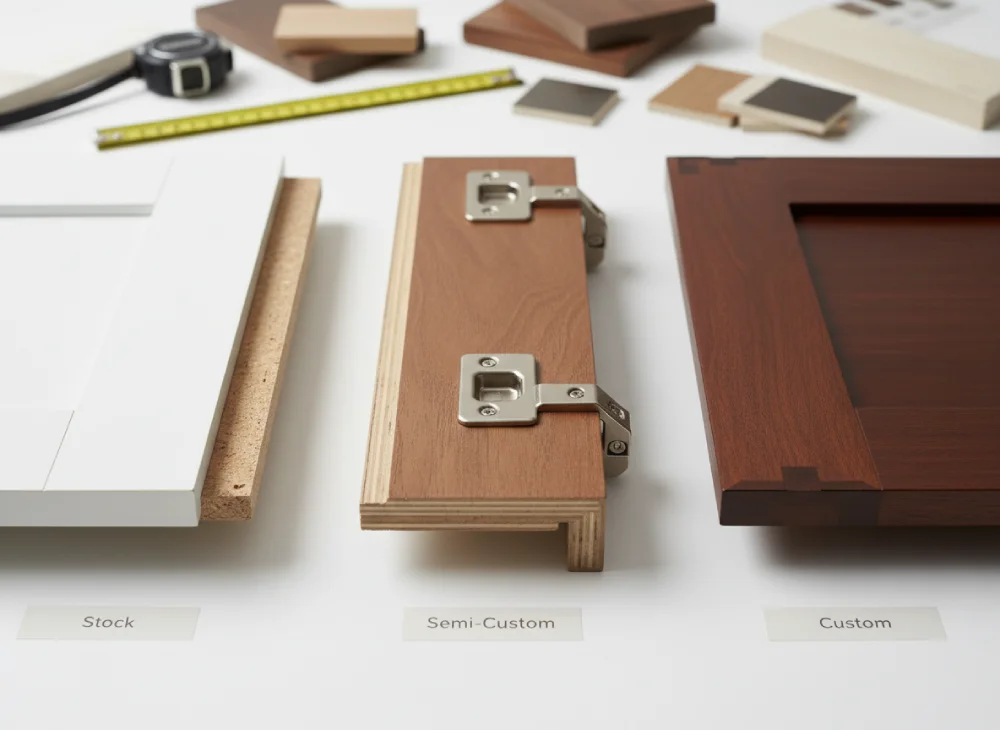
Choosing between stock, semi-custom, and custom cabinets depends on balancing multiple factors specific to your kitchen renovation project. Budget obviously plays a primary role, but timeline constraints, layout challenges, and aesthetic goals all influence which cabinet type delivers optimal value.
Budget Considerations
Budget often narrows options immediately. If you're working with $5,000 for a small kitchen, custom cabinets simply aren't feasible. Stock cabinets or ready-to-assemble options become necessary choices. For mid-range budgets ($15,000–$30,000), semi-custom cabinets provide the sweet spot of quality and customization.
Luxury budgets ($50,000-plus) enable custom cabinetry that transforms kitchens into showpieces. However, even with substantial budgets, many homeowners find semi-custom cabinets offer sufficient personalization at significant savings that can be redirected toward premium countertops, appliances, or flooring.
Budget allocation guidelines:
- Tight budget (under $10,000): Stock cabinetry with strategic upgrades
- Moderate budget ($10,000–$40,000): Semi-custom cabinets for quality and personalization
- Generous budget ($40,000-plus): Semi-custom or custom based on specific needs
- Unlimited budget: Custom-built for ultimate quality and uniqueness
Remember that cabinets typically represent 30–40% of total kitchen renovation costs. Allocating your budget wisely across all elements creates more cohesive results than overspending on one component.
Timeline Requirements
If you need cabinets installed within three weeks—perhaps due to appliance delivery schedules or living situation constraints—stock cabinets become the only viable option. Semi-custom requires patience for the 4–8 week production cycle. Custom work demands even more time, with 8–16-plus weeks standard for quality craftsmanship.
Timeline pressure often forces compromises. A homeowner who would prefer semi-custom may choose stock if their rental lease expires before semi-custom production completes. Conversely, someone building a new home with flexible move-in dates can comfortably select custom options.
Layout Challenges
Your kitchen layout significantly influences which cabinet type makes sense. Standard rectangular kitchens with typical dimensions (say, walls measuring 120", 96", and 144") work perfectly fine with stock cabinets. Minor gaps accommodate filler strips without major visual impact.
Kitchens with irregular shapes, angled walls, sloped ceilings, or non-standard window placements benefit enormously from semi-custom or custom solutions. Semi-custom cabinets often suffice for most layout challenges, with custom reserved for truly unusual spaces where precise measurements prevent any wasted space.
Making Your Decision: Professional Recommendations
After understanding the three basic types of cabinets, homeowners still wonder: which should I actually choose for my project? These guidelines help you decide based on real-world scenarios.
Choose Stock Cabinets When...
Stock cabinetry makes sense for specific situations where speed and budget outweigh customization desires. Rental properties benefit from stock installations that provide functional storage without premium investment. Basement kitchenettes, laundry rooms, and utility spaces rarely justify semi-custom or custom expenditures.
House flippers find stock cabinets offer excellent return on investment. The quick installation timeline accelerates project completion, and modern stock quality satisfies most buyers' expectations. DIY renovators appreciate RTA cabinets that simplify installation without professional help.
If your kitchen has standard dimensions and you're content with popular styles (white Shaker cabinets remain timeless), stock options deliver perfectly adequate results. The money saved can fund other priorities like high-end appliances or luxury countertops.
Choose Semi-Custom Cabinets When...
Semi-custom represents the optimal choice for most homeowners renovating their primary residences. This tier provides 90% of custom functionality at 60% of the cost—exceptional value that explains why semi-custom dominates the market.
When you want a variety of door styles and colors beyond stock limitations, semi-custom delivers. If your kitchen layout includes one or two non-standard measurements requiring custom dimensions, semi-custom accommodates these needs affordably. Homeowners seeking specific organization inserts like pull-out spice racks, trash bins, or utensil dividers find semi-custom lines offer extensive options.
Semi-custom excels for:
- Forever homes: Quality worth the investment for long-term living
- Specific feature needs: Custom storage solutions and accessories
- Moderate layout challenges: A few walls requiring non-standard cabinet sizes
- Design preferences: Particular door styles, finishes, or hardware not available in stock
The 4–8 week lead time fits most renovation schedules. Homeowners planning projects months in advance easily accommodate this timeframe. The quality construction ensures cabinets remain beautiful and functional for decades.
Choose Custom Cabinets When...
Custom cabinetry becomes necessary—not just desirable—in specific circumstances. Kitchens with highly irregular shapes demand custom solutions. If you have curved walls, unusual ceiling angles, or non-90-degree corners, custom-built cabinets provide the only way to achieve seamless fits without visible gaps.
When you require specific exotic wood types unavailable in semi-custom lines, custom work becomes essential. If you're matching existing cabinetry in another part of your home or replicating a specific historical style, craftsmen can duplicate details precisely.
Homeowners with very specific visions that semi-custom options can't accommodate—perhaps integrating technology in unique ways or creating specialized storage for unusual collections—benefit from custom work. The unlimited customization brings truly unique visions to life.
Luxury homes where budget is secondary to achieving perfection naturally gravitate toward custom cabinetry. The premium quality materials, superior craftsmanship, and exact specifications create showcase kitchens that become home centerpieces.
Materials and Construction Quality Across Cabinet Types
Understanding material and construction differences helps homeowners evaluate whether higher-tier cabinets justify their premium costs. The quality gap between tiers is substantial and directly impacts longevity, functionality, and aesthetics.
Stock Cabinet Construction
Stock cabinets typically feature particleboard or MDF (medium-density fiberboard) boxes with laminate or wood veneer on visible surfaces. While this keeps costs low, particleboard is vulnerable to moisture damage and may sag over time when supporting heavy loads.
Doors often use particleboard cores with wood veneer facings. Hinges are generally basic overlay styles that may require adjustment over time. Drawer boxes use thin materials with stapled or doweled joints that can separate with heavy use. Drawer glides are typically side-mount epoxy-coated metal that functions adequately but lacks the smooth operation of higher-end options.
Semi-Custom Cabinet Construction
Semi-custom cabinets are high-quality cabinets with plywood box construction that significantly outperforms particleboard. Plywood resists moisture better, holds fasteners more securely, and maintains structural integrity under heavy loads for decades.
Doors feature solid wood frames with wood veneer or MDF center panels, providing authentic appearance with dimensional stability. Many lines include dovetail drawer construction—interlocking joints that create exceptionally strong drawer boxes. Soft-close undermount drawer glides operate smoothly and prevent slamming, protecting both contents and cabinet structure.
Hinges are typically concealed European styles with soft-close mechanisms. These adjustable hinges allow fine-tuning door alignment even years after installation. The overall construction quality ensures semi-custom cabinets remain functional and attractive for 20-plus years with proper care.
Custom Cabinet Construction
Custom cabinets feature solid wood throughout—not just on visible surfaces but also for box construction. Premium plywood is sometimes used where solid wood would be impractical, but never particleboard or low-grade materials.
Dovetail joinery appears not just in drawers but often in face frames and door construction. Mortise-and-tenon joints create doors that won't rack or twist over time. Multiple coats of hand-applied finish—often 5–7 coats with sanding between each—create depth and durability impossible with factory spray systems.
Hardware is often custom-selected from premium manufacturers or even custom-machined for unique designs. Soft-close mechanisms are universal, with heavy-duty glides supporting substantial weight. The attention to detail extends to unseen areas—interior finishes match exterior quality, and even hardware mounting blocks receive careful attention.
Maximizing Value in Your Cabinet Investment
Regardless of which cabinet type you select, certain strategies maximize the value of your investment and ensure satisfaction with your kitchen renovation results.
Focus on Functionality First
Before getting swept up in aesthetics, ensure your cabinets offer practical storage solutions for your specific needs. Consider your cooking style, entertaining frequency, and kitchen workflow patterns. Do you need extensive drawer storage for pots and pans? Would a pull-out trash bin simplify your routine? Does your baking habit require dedicated storage for stand mixers and accessories?
Semi-custom and custom options excel here, offering organization inserts tailored to your actual usage. Even stock cabinets often accommodate aftermarket organizers that dramatically improve functionality. Invest in features you'll use daily rather than aesthetic upgrades you'll rarely notice.
Balance Investment Across Kitchen Elements
Cabinets are important, but they're one component of comprehensive kitchen design. Allocating 80% of your budget to custom cabinets while settling for laminate countertops and basic appliances creates an unbalanced result. Most designers recommend distributing budgets proportionally across cabinetry (30–40%), countertops (15–20%), appliances (15–20%), labor (15–20%), and other elements.
Semi-custom cabinets often enable this balance by providing quality and customization without consuming your entire budget. The savings compared to custom can fund premium countertops or professional-grade appliances that equally impact your kitchen's functionality and appearance.
Consider Long-Term Value
Quality cabinets represent multi-decade investments. Stock cabinets lasting 10–15 years may seem adequate, but replacing them means disrupting your kitchen again. Semi-custom and custom options easily serve 25-plus years, effectively spreading their higher initial costs across many more years of use.
For homeowners planning to remain in their homes long-term, investing in higher-quality construction makes financial sense. The superior materials withstand daily use better, maintain their appearance longer, and can even be refinished if you want to update aesthetics without replacing cabinets entirely.
Conclusion
Understanding the similarities and differences between stock, semi-custom, and custom cabinets empowers homeowners to select the cabinet type that aligns with their budget, timeline, and renovation goals. Stock cabinetry delivers immediate availability and affordability for tight budgets and quick projects. Semi-custom cabinets provide the ideal balance of quality, customization options, and value that suits most kitchen renovations. Custom-built cabinets offer unlimited design freedom and premium craftsmanship for homeowners with specific visions and generous budgets.
Your choice depends on which factors matter most. If budget and speed are paramount, stock cabinets work perfectly fine. If you want personalized touches, better materials, and precise fits without luxury pricing, semi-custom cabinets would be optimal. If perfection and uniqueness justify any investment, custom cabinetry delivers uncompromising quality.
Working with an experienced cabinet maker provides the expertise to help you decide which option brings your vision to life while respecting your budget and timeline. Contact CabStone to explore cabinet options and cabinet installation services, and receive professional guidance on selecting the perfect cabinetry solution for your kitchen renovation.
Frequently Asked Questions
What's the main difference between stock and semi-custom cabinets?
Stock cabinets are pre-built in standard sizes with fixed 3-inch increments and limited variety, available immediately at $100–$300 per linear foot. Semi-custom cabinets provide adjustments in 1-inch increments with extensive door styles and customization options at $400–$900 per linear foot, requiring 4–8 weeks production time for personalized features.
Are semi-custom cabinets worth the extra cost over stock?
For most homeowners renovating their primary residence, semi-custom cabinets offer exceptional value. The ability to adjust cabinet sizes eliminates wasted space from filler strips, while plywood construction outlasts particleboard. The range of door styles, colors and finishes, and organization inserts justify the premium for long-term quality and personalization.
How long do I have to wait for custom cabinets?
Custom cabinets require 8–16-plus weeks for production by skilled woodworkers or craftsmen. Complex designs with exotic wood types or intricate details may extend timelines further. Semi-custom cabinets need 4–8 weeks, while stock cabinets are available in 0–3 weeks, often with same-day pickup for immediate installation.
Can I get soft-close drawers with stock cabinets?
Most stock cabinetry includes basic drawer glides without soft-close mechanisms. However, some premium stock lines now offer soft-close as upgrades. Semi-custom cabinets generally include soft-close drawer glides and hinges as standard features, while custom-built cabinets always incorporate premium hardware with soft-close functionality.
What materials are used in each cabinet type?
Stock cabinets typically use particleboard boxes with laminate or thin wood veneer. Semi-custom cabinets feature plywood construction with solid wood doors and wood veneer panels. Custom cabinetry uses solid wood throughout or premium plywood, with hand-selected wood species and superior joinery like dovetails and mortise-and-tenon construction.
Do custom cabinets always cost more than semi-custom?
Yes, custom cabinets consistently cost more due to individual craftsmanship, premium quality materials, exact specifications, and unlimited customization. Costs start around $1,000 per linear foot versus $400–$900 for semi-custom. However, extensive modifications to semi-custom cabinets can sometimes approach custom pricing while still offering less design freedom.
Which cabinet type is best for rental properties?
Stock cabinetry works best for rental properties where budget consciousness and quick installation outweigh customization needs. The immediate availability and lower costs allow landlords to renovate efficiently. Modern stock quality satisfies tenants' expectations while preserving landlord profits. Ready-to-assemble options further reduce installation expenses.
Can semi-custom cabinets fit unusual kitchen layouts?
Semi-custom cabinets accommodate most layout challenges through 1-inch dimensional adjustments and depth modifications. They eliminate or minimize filler strips in many non-standard spaces. However, truly irregular layouts with angled walls, curved features, or non-90-degree corners may still require custom-built solutions for seamless fits.
How do I choose between semi-custom and custom cabinets?
Choose semi-custom cabinets when you want quality construction, personalized features, and dimensional flexibility within reasonable budgets. Choose custom cabinets only when you need exotic wood types unavailable in semi-custom lines, require exact matches to existing cabinetry, or have highly irregular kitchen layouts that demand precision-built solutions.
What's the return on investment for different cabinet types?
Semi-custom cabinets typically offer the best return on investment, providing quality and customization that appeals to future buyers without over-improving for your neighborhood. Custom cabinets may not recoup their full premium cost unless in luxury home markets. Stock cabinets work for budget renovations but may limit resale appeal in competitive markets.