Custom Kitchen Cabinets in Middleton, MA: Complete Guide
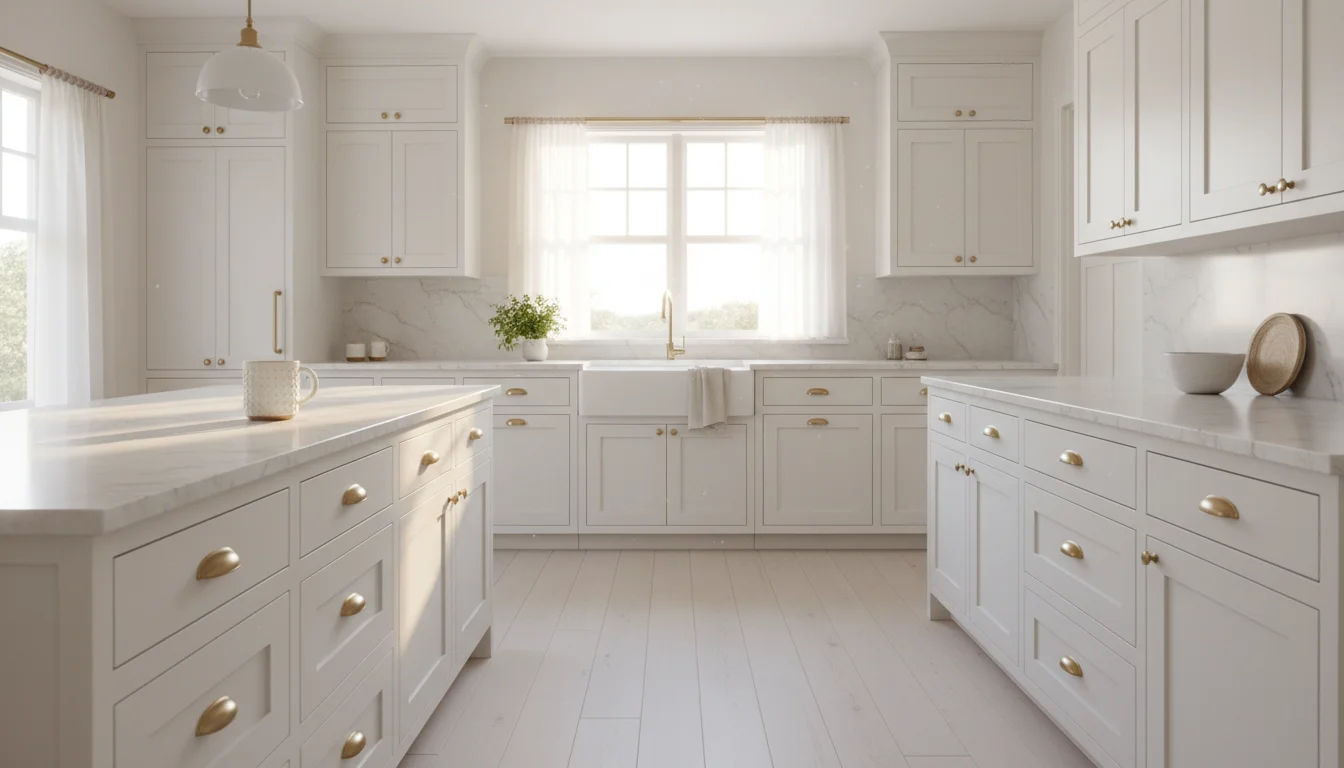
Custom kitchen cabinets give Middleton homeowners complete control over materials, dimensions, and design — something stock and semi-custom options can't match. Whether you're gutting a dated galley kitchen or adding storage to an open-concept remodel, this guide covers the decisions that actually matter: materials, construction methods, layout planning, and how to vet a qualified cabinetry contractor in Massachusetts.
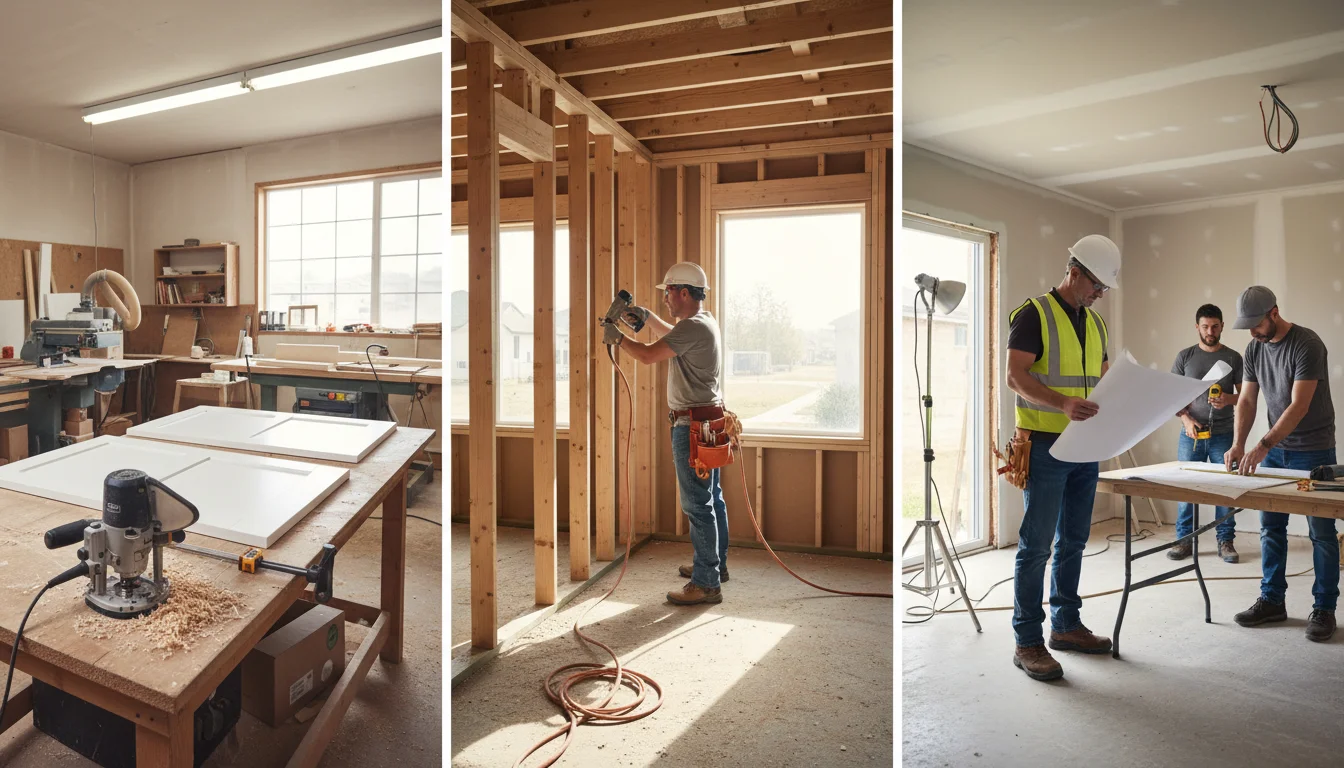
If you're exploring a kitchen cabinet remodel in the North Shore area, CabStone handles design, material selection, and installation under one roof — no subcontractors, no finger-pointing.
This guide walks you through every phase of the process so you can make informed choices and avoid the mistakes we see homeowners make every week.
What Makes Custom Kitchen Cabinets Worth It on the North Shore?
Custom kitchen cabinets are built to your kitchen's exact measurements, your preferred materials, and your family's actual storage habits — eliminating the compromises that come with stock cabinetry off a showroom floor.
Here's the thing. Most kitchens in Middleton and the surrounding North Shore towns were built decades ago, with layouts that don't match how families cook and live today. Older colonial and Cape Cod homes — the backbone of this area's housing stock — feature quirky wall angles, uneven floors, and nonstandard ceiling heights. Stock cabinets from big-box stores assume everything is perfectly square. Custom cabinets don't.
When you work with a local kitchen cabinet maker, the process starts with precise measurements of your actual space. That means filler strips and awkward gaps disappear. Corner cabinets use every inch. Upper cabinets reach the ceiling if you want them to. The result isn't just better looking — it's genuinely more functional.
A few practical advantages worth considering:
- Tailored dimensions that fit old New England homes with irregular walls, angled ceilings, and non-standard window placements
- Material choice down to the cabinet box, face frame, and door panel — not a one-size-fits-all package
- Hardware and accessories selected for how your family actually uses the kitchen, from pull-out spice racks to deep drawer organizers
- Finish control including paint-grade, stain-grade, and specialty coatings that hold up to Massachusetts humidity swings
| Feature | Stock Cabinets | Semi-Custom Cabinets | Full Custom Cabinets |
| Sizing | Fixed standard widths | Limited modifications | Built to exact dimensions |
| Material Options | Particleboard/melamine | Select hardwoods, MDF | Any material combination |
| Lead Time | Immediate to 2 weeks | 4–8 weeks | 6–12 weeks |
| Design Flexibility | Minimal | Moderate | Complete |
| Fit for Older Homes | Poor — requires fillers | Acceptable | Ideal — no compromises |
Choosing Cabinet Materials: MDF, Plywood, and Hardwood Explained
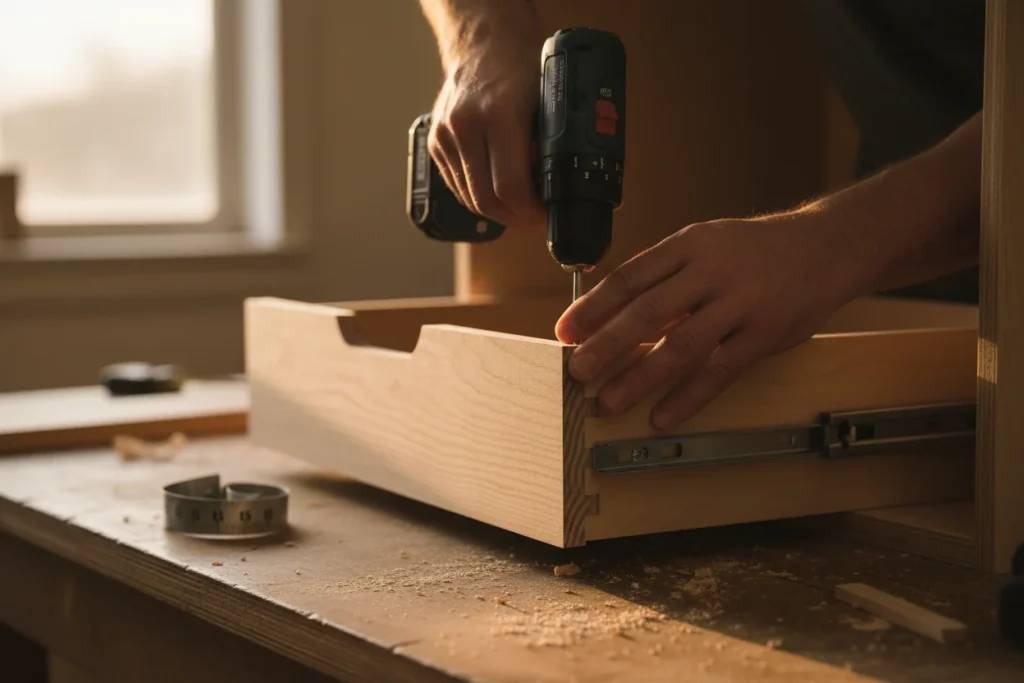
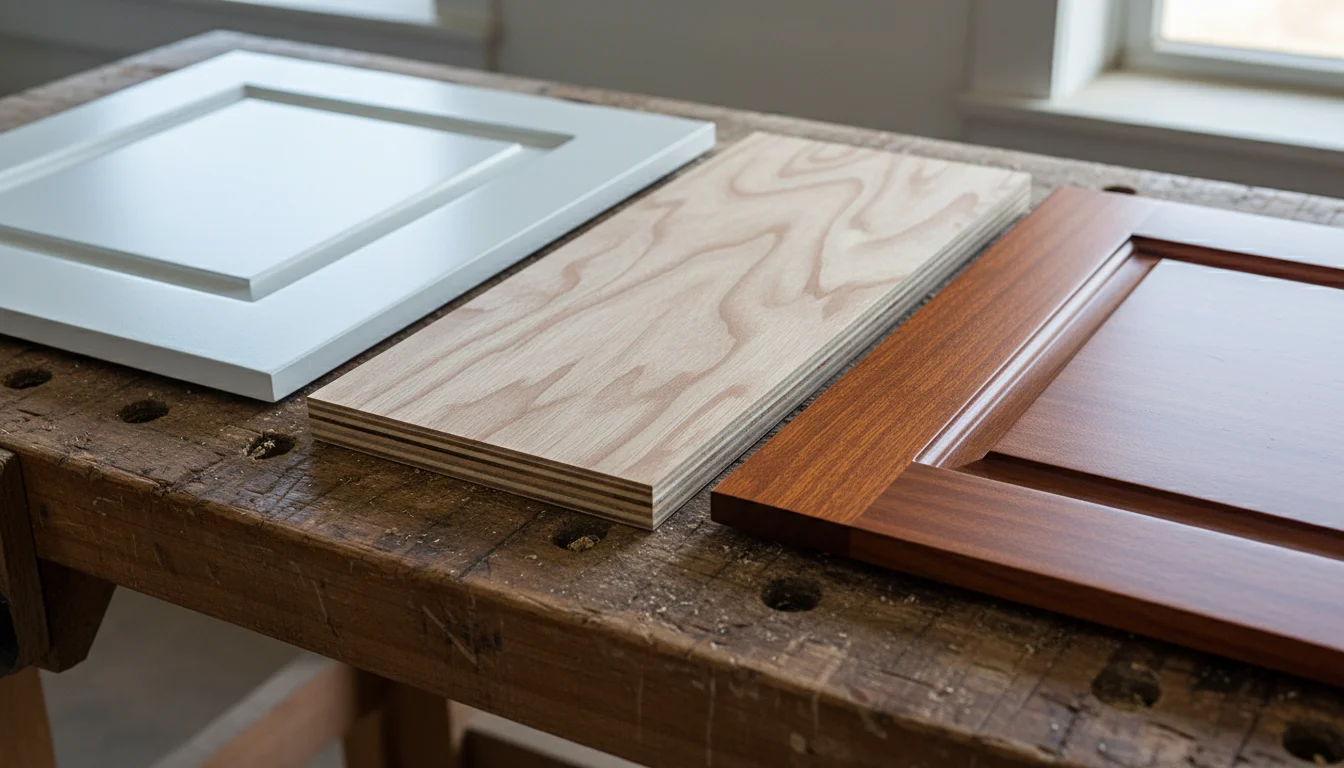
The three primary materials used in custom cabinet construction — MDF, plywood, and solid hardwood — each serve different purposes depending on whether you're building the cabinet box, the door, or the face frame.
This is where homeowners get the most confused, and where some contractors take shortcuts. Let's break it down plainly.
MDF (Medium-Density Fiberboard)
Medium-density fiberboard (MDF) is an engineered wood product made from wood fibers bonded with resin under heat and pressure. It has a completely uniform density with no grain, knots, or directional weakness. That's what makes it the go-to choice for paint-grade cabinet doors — it accepts paint beautifully and machines into crisp profiles without the risk of grain telegraphing through the finish.
The concern homeowners raise most often is formaldehyde. Here's what you need to know: the EPA's TSCA Title VI standards require all composite wood products sold in the United States to meet strict emission limits. Any MDF used in reputable cabinet installation work today must be labeled TSCA Title VI compliant. If your contractor can't confirm that, keep looking.
Plywood
Plywood is the industry standard for cabinet boxes — the structural shell that holds everything together. It's layered, cross-grained, and strong relative to its weight. Quality cabinet-grade plywood resists warping better than particleboard and holds screws more reliably, which matters when you're hanging upper cabinets loaded with dishes.
Solid Hardwood
Maple, cherry, oak, and birch are the most common species for face frames and stain-grade doors. Solid hardwood shows natural grain, takes stain well, and lasts decades when properly finished. The downside is cost — hardwood doors run significantly more than MDF paint-grade alternatives.
For most Middleton kitchen projects, we recommend a hybrid approach: plywood boxes for structural integrity, hardwood face frames for durability at stress points, and either MDF or hardwood doors, depending on whether you're painting or staining.
| Material | Best Used For | Strengths | Limitations |
| MDF | Paint-grade doors, decorative panels | Smooth finish, no grain, consistent | Swells with moisture, heavy |
| Plywood | Cabinet boxes, shelves, structural panels | Strong, warp-resistant, holds screws | Visible edge layers require banding |
| Solid Hardwood | Face frames, stain-grade doors, drawer fronts | Natural beauty, longevity, refinishable | Higher cost, seasonal movement |
| Particleboard | Budget cabinet boxes (not recommended) | Low cost | Weak screw hold, moisture damage |
Kitchen Layout and the Work Triangle: Getting the Bones Right
Your cabinet layout should be driven by how you actually move through the kitchen — not by what fits in a catalog. The kitchen work triangle, a design principle dating back to the 1940s, still provides the foundation for efficient kitchen planning.
The concept is straightforward: the three primary work zones — the sink, the cooktop, and the refrigerator — form a triangle. Each leg of that triangle should measure between four and nine feet, and the total perimeter shouldn't exceed 26 feet. No leg should be blocked by an island, peninsula, or tall cabinet.
Sound familiar? It should — the NKBA's kitchen planning guidelines formalize these dimensions alongside dozens of other standards for clearances, walkways, and landing areas.
Why This Matters for Custom Cabinets
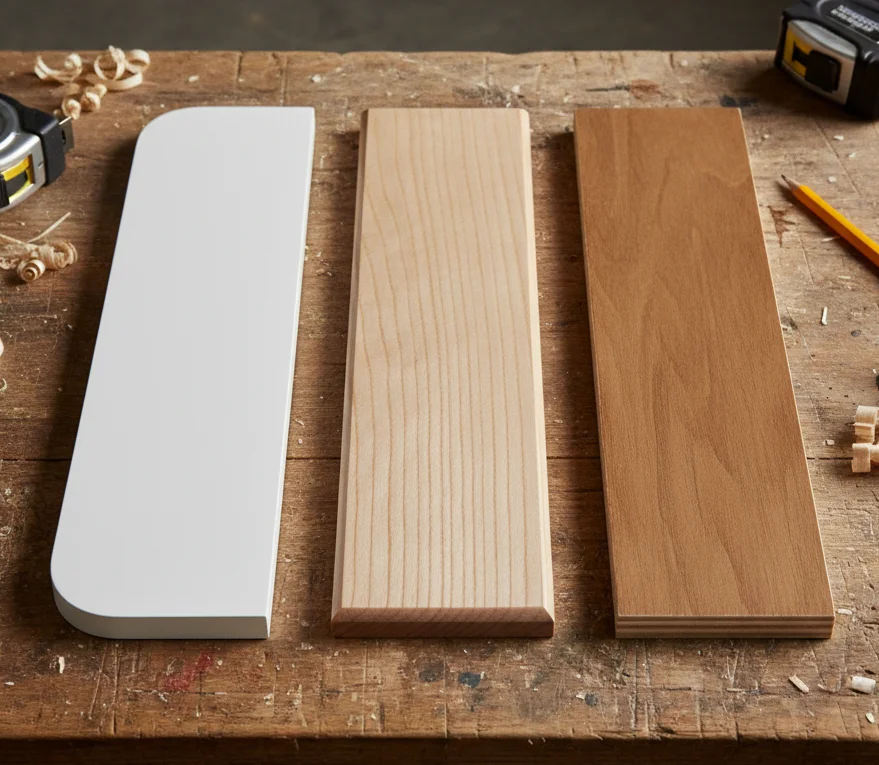
Here's where custom cabinetry pays for itself. With stock cabinets, you're fitting a predetermined set of boxes into your kitchen. With custom, you're designing the cabinetry around the work triangle and your family's cooking patterns.
For example, a family with two regular cooks needs a minimum 48-inch work aisle between opposing counters. A single-cook household can work with 42 inches. Pull-out pantry towers should sit outside the primary work triangle to avoid traffic jams. The dishwasher should land within 36 inches of the sink's nearest edge.
These aren't opinions — they're standards that separate a functional kitchen from one that drives you crazy every morning.
Modern Zone-Based Layouts
Larger kitchens, especially in open-concept North Shore renovations, often outgrow the traditional triangle. Many designers now use a zone-based approach: a prep zone (sink and cutting area), a cooking zone (cooktop and oven), a cleaning zone (dishwasher and trash), and a storage zone (pantry and refrigerator). Custom cabinets let you build dedicated storage into each zone, keeping tools and supplies exactly where you need them.
| Layout Type | Best For | Work Triangle Compatibility | Custom Cabinet Advantage |
| L-Shaped | Open-plan kitchens | Strong natural triangle | Corner cabinet optimization |
| U-Shaped | Dedicated kitchen rooms | Excellent — three-wall access | Maximum storage density |
| Galley | Narrow spaces, older homes | Modified two-wall triangle | Custom depths to maximize aisle width |
| Island | Large kitchens, multi-cook homes | Island as triangle anchor point | Integrated prep sink, storage, seating |
Hiring a Qualified Cabinet Contractor in Massachusetts
Massachusetts law requires any contractor performing residential renovation work — including kitchen cabinet installation — on an owner-occupied property to hold a valid Home Improvement Contractor (HIC) registration through the Office of Consumer Affairs and Business Regulation.
This isn't optional. It's state law. And it's the single fastest way to separate a legitimate cabinetry contractor in Massachusetts from someone working out of their garage.
What to Verify Before Signing
The HIC registration is your baseline. But there's more to check:
- Active HIC registration number — verify it through the Massachusetts Office of Consumer Affairs. Every contract, permit, and advertisement must include this number.
- General liability insurance and workers' compensation — if they can't produce current certificates, walk away.
- A written contract for any project over $1,000 — Massachusetts law requires this, covering scope, timeline, payment schedule, and dispute resolution.
- References from completed kitchen projects — not just bathroom vanities or closets, but full kitchen cabinet installs.
Red Flags That Cost Homeowners Money
After years as a design build home contractor on the North Shore, we've seen the same problems repeat. Contractors who won't provide a fixed timeline. Contractors who demand more than one-third of the total project cost upfront. Contractors who subcontract the installation to a crew they've never worked with.
Custom cabinetry is precision work. The person designing your cabinets should be closely connected to the team installing them. At CabStone, design, fabrication oversight, and installation happen under one roof — and that's not a sales pitch, it's how you prevent the "that's not what I ordered" conversation that derails kitchen projects across the North Shore every month.
The HIC Guaranty Fund
Here's something most homeowners don't know: when contractors register with Massachusetts, they contribute to a Guaranty Fund that can compensate homeowners up to $25,000 for unpaid judgments against registered contractors. If your contractor isn't registered, you lose access to this protection entirely.
Key Takeaways
- Custom cabinets eliminate the filler strips and compromises that stock options force on older North Shore homes with non-standard dimensions.
- Plywood boxes with hardwood face frames offer the best structural value for most Middleton kitchen projects.
- MDF is the superior choice for painted doors — smooth, consistent, and compliant with current EPA formaldehyde standards.
- The kitchen work triangle remains the foundation of good layout planning, whether your kitchen has three work centers or six.
- Massachusetts requires all contractors performing residential renovation work to hold a valid Home Improvement Contractor registration.
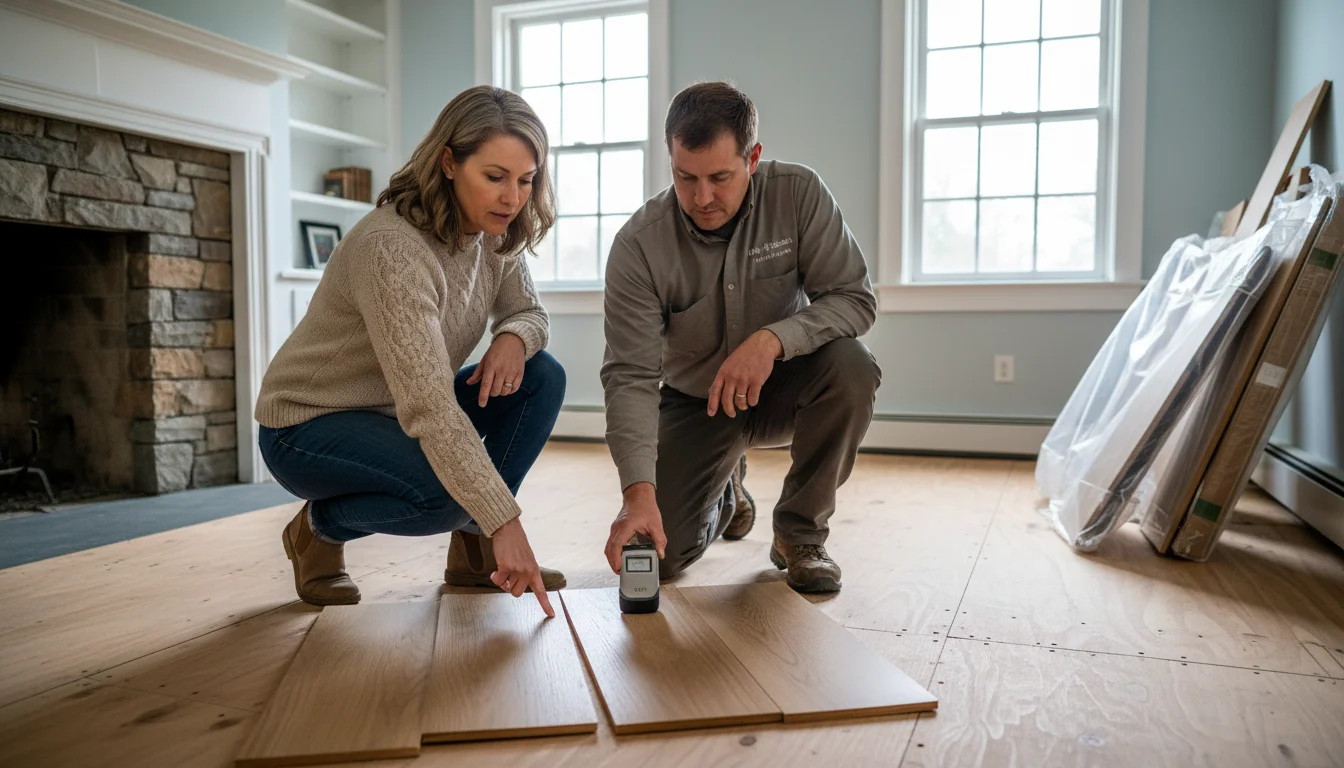
- Cross-hub keywords integrated for interlinking: topics such as flooring installation and overall home-improvement contractor selection overlap directly with your kitchen project planning.
Frequently Asked Questions
What are custom kitchen cabinets made of?
Custom kitchen cabinets typically combine plywood boxes for structural strength, hardwood or MDF doors depending on the finish, and solid hardwood face frames. The material mix depends on your budget and whether you prefer a painted or stained look.
How long does a custom cabinet installation take in Massachusetts?
Most full kitchen cabinet installations in Middleton and the North Shore take one to three weeks for the installation phase. Total project timelines — including design, fabrication, and lead time — typically run eight to fourteen weeks.
Are custom cabinets worth it for older New England homes?
Yes. Older colonial and Cape Cod homes often have non-standard wall angles, uneven floors, and irregular ceiling heights. Custom cabinets are built to fit these conditions exactly, eliminating the filler panels and wasted space that stock options require.
What is the kitchen work triangle and why does it matter?
The kitchen work triangle connects the three primary work zones — sink, cooktop, and refrigerator — in a layout that minimizes walking distance. Each leg should measure four to nine feet, with no obstructions. It's the foundation of efficient kitchen layout planning.
How do I verify a kitchen cabinet contractor in MA?
Check their Home Improvement Contractor registration number through the Massachusetts Office of Consumer Affairs. Every registered contractor is required to display their HIC number on all contracts, permits, and advertising.
What is the difference between MDF and plywood cabinets?
MDF is an engineered fiberboard that's smooth, uniform, and ideal for painted surfaces. Plywood is layered wood veneer that's stronger, lighter, and better at holding screws — making it the preferred material for cabinet boxes and shelving.
Should I paint or stain my kitchen cabinets?
Paint works best on MDF doors, providing a clean, modern look. Stain requires solid hardwood or high-quality wood-veneer doors, showcasing the natural grain. Your choice affects both the door material and the overall project cost.
What does a custom kitchen cabinetry project include?
A full-service project includes design consultation, precise field measurement, material selection, fabrication coordination, professional installation, hardware mounting, and a final punch-list walkthrough with adjustments.
Do I need a building permit for kitchen cabinet installation in Middleton?
Cabinet replacement alone typically doesn't require a permit. However, if your project involves plumbing changes, electrical modifications, or structural alterations, Middleton's building department will require permits. Your contractor should handle this.
What cabinet door styles work best in New England homes?
Shaker-style doors are by far the most popular on the North Shore — clean lines that complement both colonial and contemporary interiors. Raised-panel doors work in traditional homes, while flat-slab doors suit modern renovations.
Conclusion
A custom kitchen cabinet project in Middleton, MA isn't just about picking door styles and paint colors — it's about building storage and workflow into a space that fits your family's life. From selecting the right material combination to verifying your contractor's HIC registration, the decisions you make before demolition day determine whether you'll love your kitchen for decades or regret it within a year.
If you're ready to start planning your kitchen renovation on the North Shore, CabStone walks you through every step — from initial measurement to final punch list.